Motions – Enmore Camdenville

Enmore Camdenville ALP Branch – motions passed 18 April 2011.
Please note motion 2 differs from the template motion.

  1. The Enmore Camdenville Branch endorses the findings of the 2010 National Review and demands that its Recommendations be implemented in full.
  2. The Enmore Camdenville Branch supports that the structure of State Conference shall be changed so that the following positions are filled by proportional representation, by postal ballot of the rank and file membership of the party and the affiliated unions’ conference delegates, with each constituency having a 50% weighting in the final outcome:
    • President, Senior President and Junior Vice Presidents
    • General Secretary and Assistant Secretaries
    • All elected members on the Administrative Committee.
  3. The Enmore Camdenville Branch calls for Union delegates to Conference to be chosen by direct election by union members and requires that representation at State Conference by each affiliated union shall be conditional on the union selecting its delegates to Conference by direct election by the members of the union.
  4. The Enmore Camdenville Branch is anti branch stacking and demands that all members must pay their own membership fees direct to head office. The only exception is for immediate family members under the age of eighteen. Members paying a concessional rate must provide a photocopy of their concession card with payment.
Posted in Branch and EC Motions | Leave a comment

Follow up Open Letter to Sam Dastyari

Dear Sam,

Thank you for your reply of 11/4.  We do indeed share some common ground.  But there remain areas of uncertainty.Do you support the four core motions passed at the rank and file meeting of April 2nd?

I support your suggestions of an Amnesty and Primaries, but neither will make membership more attractive than it is now.

Banning factions would make membership more attractive, but how would it be done?

  • How would such a ban be worded?
  • How would such a ban be enforced?
  • Given that the factions traditionally dominate conference, how would the numbers be available at conference to effect such change?

Pending answers to the above three questions, “the end of the factional system at a State Parliamentary level”, or at any other level, seems less than assured.

What would give the grassroots rank and file member more reason to stay in the party is visible evidence that the worst excesses of the factions are being reined in. For example, you could choose to express your support for some or all of the core OurALP motions.

Or, may I request your support for the following two motions, passed by my own branch of Alexandria:

1. Intervention in preselections only in genuinely exceptional circumstances.

Rank and file preselections may not be overridden or delayed except in exceptional circumstances. The following are not exceptional circumstances: unproven allegations of branch stacking; star candidates; insufficient time to hold a preselection; desire for balance in gender representation; low membership levels; nor any reasonably foreseeable event. Proven allegations of branch stacking may be grounds for delaying a preselection. The following is exceptional circumstances: no nominations being received by close of nominations.If there is insufficient time for a preselection prior to the close of nominations, then any member may without repercussion nominate themselves for office, and all party members are required to vote for all such nominees in an order to be determined between the close of nominations and polling day but otherwise conducted as per the normal preselection process.

2. Timely conduct of Preselections

If one year prior to the earliest date on which a General Election can be reasonably expected, nominations for an electorate have not been called, the local Electoral Council is empowered to conduct its own preselection, following the usual rules for a preselection. One month’s prior notice must be given to all branches in the Electorate and to the Administrative Committee before an Electoral Council can vote to conduct its own preselection.

As you and I experienced with the Gilmore preselection, for example, there is little that causes the rank and file as much upset as having preselections delayed or preempted.  As with the four core OurALP motions, these motions do not call for the end of factional influence, only that it be exercised differently – through persuasion rather than diktat.

PS More than one person has asked me if the membership of the Administrative Committee is a secret. Is it?

Regards, Ben Aveling,
Secretary, Alexandria Branch

Posted in Misc | Leave a comment

A Submission from Mt Colah – Berowra

A SUBMISSION TO ADDRESS NONCOMPULSORY UNION MEMBERSHIP IN THE ALP AND BRANCH MEMBERS INVOLVEMENT IN UPPER HOUSE PRESELECTIONS

 Introduction

The massive defeat of the NSW Labor Government on 26 March is without doubt the worst result in the history of the NSW ALP. The defeat of the Unsworth Government cannot be remotely compared with what happened and there will no doubt be another investigation into the catastrophe. If the “new” review refuses to make recommendations that gives real democracy to all branch members and creates an organisation that reduces factional power and excessive union influence, then nothing will change and the event on 26th of March will have been in vain. But more importantly, the ALP will remain an organisation which will still be regarded by the Australian public as just another political party which considers Tammany Hall politics as normal business.

The 2010 National Review recently released by Steve Bracks, John Faulkner and Bob Carr hands down 31 recommendations. Recommendations three to seven discuss processes to increase Party membership but ignore the fact that an increase in membership cannot be achieved without changes to Party rules concerning mandatory trade union membership prior to joining the Party. It is a fact that most Australians do not agree with compulsory unionism. Therefore, unless the appropriate clauses in the ALP rules reflect today’s Australia people will not join the party. Recommendation eight may coax some ex-members to return, but unless real changes are made to the Party, many of these members will not return. The reason they left in the first place was that Head Office refused to introduce democratic reforms.

It is encouraging that recommendations 13, 14, 16, 17and 26 at least attempts to address some issues to improve democracy within the organisation. But recommendation 26, which suggests changes to lower house preselection, is an insult to Party members, particularly in NSW. Hence in NSW this recommendation reduces rank and file involvement in the preselection process by 40 percent and increases union influence by 20 percent in lower house preselections. The only advantage in this change is that at least it involves Labor supporters from the Australian community.

There is nothing in the recommendations which addresses the most contentious issue concerning branch members, and if introduced, will result in making the ALP a truly progressive party relatively free of factionalism and union patronage. It is essential that ALP rules are changed so that branch members are permitted to be involved in upper house preselections similar to the system now used in lower house preselections. There is no doubt that the current system is now outmoded and is the main driver of factions and trade union mateship.

This submission covers the two major issues of contention within the ALP: the removal of clauses in the rules regarding compulsory union membership and the introduction of real democracy within the ALP by involving all branch members in the process of upper house pre-selections for both the Legislative Council and Senate.

It is recognised that the changes under debate involve the State, Territories and National ALP. Hence even though this submission addresses the NSW ALP all the recommendations are relevant to the national ALP.

NONCOMPULSORY UNION MEMBERSHIP IN THE ALP

The amendment of ALP Rules on compulsory membership of trade unions for new members and for pre-selection of candidates for public office is covered in Sections A, I and N.

The rules on the admission of new members and pre-selection of candidates for public office are in need of revision with respect to trade union membership. Current ALP policy does not support compulsory trade union membership within the work force and the Australian public, although they may support trade unions, also is not in favour of compulsory membership of trade unions. Union membership levels released in August 2010 was 22% fulltime and 15% part time employees. Hence ALP rules with respect to compulsory union membership for new members and pre-selection candidates should be reviewed and amended accordingly because they are now outmoded.

It is expected that trade unions will resist these rule changes even thought they realise that union membership is no longer mandatory. This attitude shows that some in the trade union movement are not prepared to accept sensible and realistic changes. This resistance demonstrates that the industrial wing of the Labour movement is fearful of losing their political power within the Labor Party. Under the proposed amended rules some new members may not elect to join trade unions. These changes should be welcomed by the union movement if they believe in freedom of choice and believe in social democracy.

Regarding new members, the relative clauses are A.5, A.6, A.7, A.13 (b), A20 (a) and I.6. These clauses should be amended to remove all reference to compulsory union membership, and clarify that new members have the freedom of choice whether to join a trade union or not.

For example, Clause A.7, which states that “An employer can only join or remain in the Party if he/she makes a genuine effort to encourage employees to become and remain members of the relevant trade union covering their work and if he/she observes applicable industrial laws, awards and agreements” must be the most outmoded of all ALP rules and has no relevance to today’s Australian community. It is recommended that this rule be removed completely.

Rule I.6 (d) requesting proof of union membership should be deleted, and subclause (e) should be revised to delete all reference to trade unions and request only proof that the new member is unemployed for membership fees purposes.

The modification of these rules as far as membership of the Party is concerned not only relates to trade union membership but also democratic pre-selection. The relevant clauses are:

Clause N.11 (a): “Have been a Party member for at least 12 months prior to the call for nominations and, also, if eligible, be a paid-up member of a trade union”.

Revised Clause: “Have been a Party member for at least 12 months prior to the call for nominations”.

Clause N.11 (f): “Proof of a candidate’s union membership, if applicable, must be provided to the ALP Office prior to the close of nomination”.

This clause would be superfluous by removing reference to trade unions in Clause (a).

Clause N.17 (b) (i) to (v) refers to voting in the pre-selection. For example, Clause (i) states: “In order to vote in a selection ballot a Branch member must also be a paid up member of a union if there is a union which he/she can join”.

Sub-clauses (i) to (v) are superfluous regarding non-compulsory trade union membership apart from the words in (iii) “has paid the wrong Party membership fee”.

BRANCH MEMBERS INVOLVEMENT IN UPPER HOUSE PRESELECTIONS

As mentioned in the introduction, unless the ALP addresses the issue of branch members involvement in the pre-selection of candidates for upper houses (Legislative Councils and the Senate), the Party will continue to bleed membership and remain an organisation lacking real democratic principles within its ranks. Labor history in Australia is a story of the fight for democratic rights for all the people and we have always been ahead or the Conservatives for equal voting rights. But the fact is that the Party has failed to practice the same democratic principles within its own ranks by granting to branch members the full democratic representation enjoyed by the Australian community.

It is painfully obvious that Sussex Street, the current leaders of the trade union movement and some members of what remains of the NSW Labor caucus after the annihilation at the recent election are not interested in granting full democratic reforms to Party members. The motive for the continued procrastination is self interest and the preservation of the faction system. There is no doubt that if Party members had the vote in pre-selection of candidates for upper houses of parliament it would remove the current system of patronisation and open the Party to real democracy. Any member wishing to stand for pre-selection would then need to lobby all Party members and compete for a position on the pre-selection list prior to facing the Australian voter.

In response to the efforts of some Party members to force changes to the current system, the NSW branch hierarchy and the Administration Committee keep repeating the myth that State Conference delivers real democracy for all delegates, and that the branches have improved their positions since the 50:50 rule. But the facts are that conference is still totally managed by the trade union and Party factional chiefs and the voting system bears no resemblance to democracy whatsoever. All voting is along factional lines and there have been cases of coercing members during the voting process.

Recommendation 26 of Review 2010 suggests that a tiered system of Party primaries be introduced for the selection of candidates, but only for lower house pre-selections. If this process is introduced, particularly in NSW, branch members lose 40 percent of the vote to trade unions and the Australian public. In NSW branch members already vote in pre-selections for lower houses of parliament at both state and national levels, but the NSW branch of the Party through the Administrative Committee has the power to overturn the results of voting by use of Section N40 Rule as deemed necessary by the Administration Committee. Hence this recommendation is an insult to branch members and will result in further membership losses.

The suggestion that the process commences “in open and non-held lower house seats and be considered for held seats in the future” is simply the usual stalling tactic used to pacify Party members. But there is not a word regarding upper house pre-selection which is the dominant issue stalling real democratic reform.

It is correct that improvements have been made with branch members having the right to vote for the election of national president and vice-presidents, but these positions have no real influence within the ALP. Recommendation 13 should be easy to carry through because the offices of National President and Vice president are basically powerless positions. This is the reason why all branch members are able to vote for these positions.

Proposed changes to the pre-selection process of candidates for public office

Most Party members accept that the process for the pre-selection of candidates for the Legislative Assembly and the House of representatives in NSW is fairly democratic (apart from the alleged over-use of the N40 Rule).

Under the current system State Conference pre-selects candidates for the NSW Legislative Council and Australian Senate and many branch members are concerned that the process is undemocratic, and requires change. The fact is that members of the Party, apart from conference delegates, have no influence whatsoever in the selection of candidates for either the Legislative Council in NSW or the Senate.

Recommendations 17 and 26 in the National review 2010 readily admit that rorting of voting at State Conferences take place. Recommendation 17 states that dual voting is undemocratic and should not be permitted. Recommendation 26 states that double or triple voting should not be permitted.

The major change in the process would be to remove the right of pre-selection of upper house candidates from State Conference and manage the process under the auspices of the NSW Branch of the ALP. Nominations would then be called using the same process as currently used for lower house pre-selection.

After credentialing by the Administration Committee, and after setting the selection date, all eligible candidates would be placed on ballot papers and sent to all eligible Party members for voting. Eligible voting members would be determined from current Party membership lists. Each candidate would then canvass members for their support prior to the date set for the ballot. The current rules for the eligibility of candidates for pre-selection are already defined under Section N of ALP Rules, and the process would be carried out under the amended rules regarding non-compulsory union membership.

This system would ensure that all candidates win their positions on the pre-selection lists in a free and fair democratic election. But more importantly, all the rank and file of the Party would have the opportunity to be involved in the democratic election process. All party members, including those members, trade union members or not have equal voting rights.

Conclusions

There is no doubt that the Party, particularly in NSW is going through a period of unprecedented political problems not encountered on such a scale over the past one hundred and twenty years. Public opinion polls two years prior to the March 26 2010 election gave the Coalition a considerable lead which, despite the election campaign run by Labor did not change. NSW Labor was considered by the public a decadent and corrupt organisation.

The only way to arrest further decline and demonstrate to the voting public that we are worthy of re-election is to institute real structural change within the organisation. This does not mean cosmetic or the usual deck-chair shuffle. It means change both on the policy front and introducing major democratic reforms. Those individuals within the Party who use the organisation as a vehicle for self-promotion and hold their positions due to factionalism will always argue against change.

The above proposal to remove the pre-selection of upper house candidates from State Conference and to give all branch members is a major change. It is recognised by branch members as a major democratic reform and it is long overdue. The reasons for the change have been discussed above and irrespective of the views of some in Caucus and in Sussex Street will remove cronyism and make the Party an organisation to be respected by the public not only of this state, but Australia wide.

Posted in Misc | 1 Comment

Lithgow Branch – Ben Aveling’s response

In response to the points raised by the Lithgow Branch on the 12th of April

Re: Motion 1.

The tight time-frame is driven by the cut-off date for submissions to conference: noon, 29th of April. That date was chosen by head office.  Several people have complained to them that it is too tight and will prevent proper consideration of motions, but to no avail. Branches either have to work with it, or accept that their motions and amendments may not be considered by conference this year. Head office have informally said that they may be flexible with late submissions, but there are no guarantees.

At least one branch has called an additional ‘special’ meeting to give members extra time to consider this motion, and others have rescheduled their regular meetings.

Re: Motion 2.

Members of affiliated unions are also part of the rank and file of the ALP, whether or not they are also party members, and they already have a say in the election of Party officers, via their conference delegates.  Of that, all that this proposal would change is to turn an indirect say into a direct say, and of the same magnitude.

That is: instead of union members voting for a secretary who chooses delegates who vote for party officers, union members would themselves vote for party officers.  There would be no change in the weighting of the total vote.  It would become less ‘winner takes all’. And it would allow union members to split their vote, for example they could vote for a certain person to be secretary without supporting that person’s choice of party officers.

If any branch feels that union members should have their say in the election of Party Officers removed, they are free to raise a motion to that effect, ideally by the 29th of April.

One of the principles advocated in the Faulkner Carr Bracks review is one vote, one value.  This motion would give all members the same amount of say in the selection of party officials, as opposed to the bias towards members of weaker electorates.  Given that there are electorates with 10’s of members and electorates with 100’s of members, whether one feels this is more fair or less fair may well depend on where one lives.

In response to your question as to who paid officials should be answerable to, as Michael Johnston has put it:

“I take the view that paid Party officials are answerable to the Rank and File – all of us!. That currently they are not is the cancer eating the heart out of our once great political party.  [It would be empowering if] Candidates offering themselves for office in the Party would tell us their qualifications, their competence, their commitment and the reasons why we should select them.”

The fact that party members do not know who sits on the Administrative Committee is no argument for denying members a vote on who sits on the Administrative Committee – it is an argument for informing party members about the people who sit on the Administrative Committee.  And it is not true that all delegates to conference are familiar with all candidates for the Administrative Committee. Almost without exception, they are familiar only with those in their own faction, if that.   Besides, factionally aligned delegates do not exercise their own judgement, they vote as instructed by their faction, regardless of their own opinion and regardless of the opinions of those they supposedly represent.

Under this proposal there would have to a distribution of candidate bios to the wider membership of the party.  No doubt, delegates will make their own recommendations to their branch members, who will then make the final decision.

Of course Motion 2 could have gone further, every motion could. That alone is no reason to oppose. Better to pass this motion and move additional extra motions as well, as other branches have done.

Re: Motion 3.

The selection of delegates to Conference by affiliated unions is not a purely internal affair of the union.  It is very much the concern of the party as a whole that the delegates from its individual member bodies are as representative as possible of their constituencies, not least because it gives those that are union members but not directly party members an awareness that it is still their ALP, something that they do not currently feel.

Re: Motion 4.

Our membership base will increase only when members perceive that they have a voice, and branch stacking destroys that voice.  It is not enough that most branches are not stacked.  A few heavily stacked branches are all that is required.

Given modern payment methods, the inconvencince caused to legitimate members in sending a cheque or paying by credit card to head office, as compared to paying by cheque or cash to a local branch secretary or MP, is minimal to non-existent, given that most branch secretraies do not accept credit cards, phone payments, or internet payments.

The vast majority of members who are entitled to concessional rates have evidence showing that they are entitiled to concessional rates.  For the minority that don’t, there is the option of a statutory declaration. The concessional rate should be reserved for those that need it. It should not be an opt-in for anyone that just wants it.

Regards, Ben Aveling

Posted in Misc | 1 Comment

Motions – Eastwood

To: AS LISTED
Re: Proposed Agenda Items for the NSW ALP State Annual Conference
To be held on Saturday 9th and Sunday 10th July 2011.

The following motions were unanimously passed at the April 2011 Annual General Meeting of Eastwood NSW Branch of the Australian Labor Party and are submitted for discussion as agenda items at the NSW ALP State Annual conference proposed to be held at the Sydney Town Hall on 9th and 10th July 2011, viz:

  1. Implementation of the public recommendations of the Faulkner, Bracks, Carr Review, without any watering down of its key recommendations.
  2. Direct elections by the rank and file of a range of Senior Party Officials.
  3. Delegates to Conference from unions to be chosen by union members.
  4. As an anti branch stacking reform: members must pay their own membership fees.

………………………………………
K.P.Townsend
Secretary, Eastwood Branch ALP

Distribution List:

General Secretary NSW ALP, Sam Dastyari
Secretary, Epping SEC
Secretary, Ryde SEC

Posted in Branch and EC Motions | Leave a comment

Extra Motions – Milton Ulladulla

At the recent meeting of the Milton Ulladulla branch of the ALP, the following motions which you forwarded for discussion were passed:

A. Support for the core motions:

  1. Endorse the 2010 Review and demand it be implemented in full.
  2. Direct elections for Admin, General Secretaries, Presidents.
  3. Union delegates to Conference to be chosen by direct election by union members.
  4. Anti-branch stacking: membership fees to be paid direct to Head Office.

The membership also moved and seconded the following motions for your consideration:

B. That the rank and file have the final decision in the placement of people on the Senate and Legislative Council ticket.

C. In light of the above motions the Milton Ulladulla branch demands a timetable for their implementation.

We look forward to receiving further progress reports and also the date/location of the next Rank and File Supporter meeting.

M Exel

Hon. Secretary.

Posted in Branch and EC Motions | Leave a comment

Sam Dastyari’s Response to Open Letter

11 April 2011

Dear Ben

Thank you for your open letter dated 4 April 2011 regarding Labor Party Reform.

As you have noted, I share your support for Labor Party Reform.  I welcome members’ engagement in this exciting process.

The Annual Conference is the supreme policy making and governing body of the Party in NSW. Please note that Rule changes to be considered at the 2011 Conference are due by 12 noon, Friday 29 April.

My strong personal views on Party reform are on the public record. I have argued for the end of the factional system at a State Parliamentary level, a membership amnesty and the consideration of new candidate selection models. In order that these views are considered by the Annual Conference, I will aslo be making a submission through the process outlined above.

Congratulations to all members involved in the public meeting held 2 April 2011. A strong culture of debate is vital to Party life and essential to our democracy.

If you have any questions, please contact the Party Office on (02) 9207 2000.

Yours sincerely,

Sam Dastyari

GENERAL SECRETARY


The open letter to Sam Dastyari is here


Posted in Misc | Leave a comment

Motions rejected – Lithgow branch

The Lithgow branch of the ALP met on 12 April and considered 4 motions adopted by the “Our ALP” gathering in Sydney on 2 April.
With regard to those motions the Lithgow branch adopted unanimously the following resolutions:

Motion 1 – Endorse the 2010 Review

That Lithgow branch notes resolution 1 and undertakes to discuss it in detail at a later date when all branch members have had the opportunity to consider the 2010 review in full.

Motion 2 – Direct Election for Administrative Commmitee, General and Assistant Secretaries and the State President and Vice Presidents

That Lithgow branch rejects motion 2.

Whilst we believe there is some merit in considering rank and file election of the State President and Vice Presidents in a manner similar to the election of the National President and Vice Presidents we do not believe the same can be said for electing by rank and file ballot the General and Assistant General Secretaries nor for the members of the Administrative Committee.

We offer the following reasons in support of our position:

  • The process proposed is not clearly worded. As written it allows for non ALP members in affiliated unions to have a vote in the election of ALP office bearers.  The election of Party officers is a matter for ALP members alone.
  • Given the markedly lower numbers of Party members in rural and regional areas the process proposed would disenfranchise those members.
  • As the General Secretary and Assistant General Secretaries are paid officials and responsible for the day to day operations of the Party, it is more appropriate for those officials to be answerable to a representative body of Party members which can meet in one place. State Conference is the appropriate body for this purpose.
  • Given the number of members of the Administrative Committee it is not practical to expect all Party members to be able to vote in an informed manner.  Rather this responsibility should be left to the 900+ delegates to the NSW State Conference.

Motion 3 – Union delegations to State Conference to be chosen by direct election by union members

That Lithgow branch rejects motion 3.

It is not the place of the Party to direct affiliated unions on how to conduct their internal affairs. The method for selecting union delegates to State Conference is a matter for each affiliated union to determine for itself.
Further, motion 2 demonstrates a fundamental misunderstanding on the part of the drafters as to how union delegations to State Conference function. Delegates from affiliated unions do not participate in Conference as individuals, rather they represent the collective position of their union.

Motion 4 – Anti branch stacking

That Lithgow branch rejects motion 4.

We believe that, in general, the current anti branch stacking provisions of the NSW ALP Rules are sufficient.
Given the current problems that NSW Labor has with respect to membership recruitment we believe the Party should be investigating ways to increase our membership base rather than restrict it.

Further we are concerned that motion 4, whilst well intentioned, would unduly affect retired people who are not necessarily able to provide evidence of concessional status. In addition the provision concerning concessional membership places an unfair burden on low income people and is an unacceptable invasion of an individual’s privacy.

If there is a question as to the concessional status of an individual member, that should be dealt with by Party officials on an individual basis with due regard for the principles of confidentiality and privacy.
In solidarity,
MG Martin
SECRETARY
13 April 2011


See also:
A response by Ben Aveling

Posted in Branch and EC Motions | 1 Comment

How Stuff Works – The (NSW) Labor Party – Part 1, Party Units

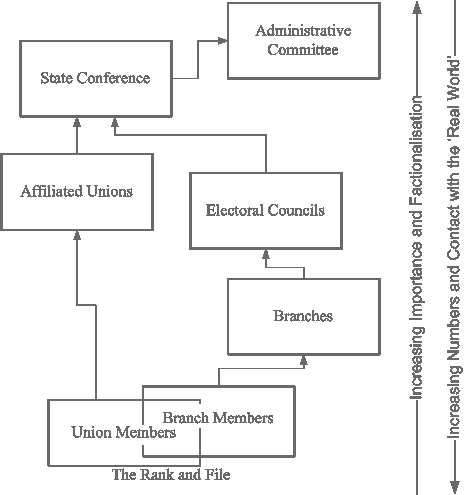
Technically speaking, the NSW Labor Party is structured as a representative democracy. In practice, outcomes are generally undemocratic for reasons examined below.

The structure in other states is broadly similar, with a range of variations, especially around numbers and ratios.

Party Units

Party Units


State Conference:

The ‘supreme decision making body’, only Conference has the power to change the rules of the Party or the Policy Platform. Conference appoints the Administrative Committee, the Party Officers (General Secretary, 2 Assistant Secretaries, and President and 3 Vice Presidents), delegates to Federal Conference, members of Machinery Committees, members of Policy Committees and candidates for the NSW Legislative Council (the NSW upper house).
Conference is composed of around 800 delegates, 50% of whom come from Afilliated Unions, around 100 delegates appointed through a range of mechanisms (16 from Young Labor, 16 to represent Federal Parliamentarians, 16 to represent State Parliamentarians, the 35 member Administrative Committee and 3 from each Policy Committe and 3 from the women’s Committee) and the remainder from State and Federal Electoral Councils. Enough Conference Delegates are members of a faction that Conference outcomes are all but totally determined by the factions.

Administrative Committee:

Also known as Admin, the Administrative Committee directs the Party between Conferences. It has most of the powers of Conference and is more important because it meets every month whilst Conference meets only once a year.
The Administrative Committee is composed of 35 members, of whom 25 are directly selected by Conference, plus the 7 Party Officers (as above), plus the State and Federal Parliamentary Leaders, plus, in a non-voting capacity, a member of Young Labor, normally the President. These 35 people are sometimes known as the ‘faceless men’, not because their identity is secret but because it is not publicised and the legwork required to identify them is beyond the ability of most Australian journalists.
The NSW Administrative Committee is totally factionalised. Committee members are either factional heavy weights or are appointed by factional heavyweights. In theory, there are be enough non-factionally alligned delegates at conference for this not to be the case, but in NSW the non-factional delegates do not vote in a sufficient block to elect any Administrative Committee Members.

Electoral Councils:

There is a State Electoral Council (SEC) for each State Electorate, a Federal Electorate Council (FEC) for each Federal Electoral Council, and a Local Government Committee for each Local Government Area. Each SEC sends 2 delegates to State Conference and each FEC sends 3 delegates to State Conference. LGCs are not represented at Conference.
Electoral Councils are composed of delegates from Branches. The size of an Electoral Council is determined by the number and size of the local branches. While the degree of factionalisation in Electoral Counciles varies, Council Executives are predominately faction members.

Branches:

Branches represent an area which can be as small as a single suburb or as large as a whole Electorate (in which case the Branch acts as the Electoral Council and is known as an Electoral Branch). Each Branch sends a number of delegates to each of its local Electoral Councils, depending on the size of the branch, and depending on whether a branch straddles an electorate boundary.
Branches are composed of party members. Most members will attend their nearest branch but members may attend any branch in their State Electorate. Regular attendance at a branch is a prerequiste for participation in preselections. Most branch members are not members of a faction, but Branch Executives are disproportionately factionalised.

Affiliated Unions:

Not all Unions are affiliated. Non affiliated unions play no structural role in the ALP. Affiliated Unions send a number of delegates to conference, depending on the size of the union’s membership. There is no restriction on how a Union chooses its delegates. In practice, most unions delegates are selected by the union secretary, meaning that delegates represent the interests of the Union secretariate first, and ordinary union members second, if at all. Many union delegates are not members of the union they nominally represent. Many union members do not even realise that they are ‘represented’ at Conference.

The Rank and File:

The expression ‘Rank and File’ normally refers either to all Party Members, or to all Party Members plus  all members of Affiliated Unions, depending on context.

It is still common, if less so than it used to be, for a person to both a party member and a union member.

Factions:

Factions are not formally part of the structure of the Labor Party, but their members compose a percentage of all party units, most especially the higher echelons. In a self-reinforcing pattern, factions are able to determine the outcome of most significant decisions, which means that they are able to command the loyalty of their members, and generally above and beyond loyalty to the rank and file. Because the main source of information about happenings higher up the structure is the delegates themselves, this conflict of interest is only rarely visible to those below. Because this dilution of democracy is repeated at every level of the structure, alignment between the rank and file and the Administrative Committee is effectively non-existent. Most of the Rank and File do not realise that they, indirectly, choose the Administrative Committee, or even that it exists.

Posted in Misc | 8 Comments

An open letter to George Wright, and any other potential candidates for the position of National Secretary

Dear Potential National Secretary,

You are proposing taking on this role at an interesting time for our party, a time when we are widely perceived as having ‘lost our way’, both federally, and in several states.

In Sydney last Saturday, a rank and file meeting of around 300 people voted for four specific reforms:

  1. Implementation of the public recommendations of the Faulkner, Bracks and Carr Review, without any watering down of its key recommendations
  2. Direct elections by the rank and file of a range of Senior Party Officials, including General Secretary
  3. That Delegates to Conference from unions are to be chosen by union members
  4. That as an anti branch stacking reform members must pay their own membership fees.

The full text of the motions is below, and is available at
https://ouralp.net/2011/03/26/the-core-motions/

Can the rank and file count on your active support for these specific reforms, and for Party reform in general?

As potential National Secretary, what is your vision for the future of the ALP, and how do you expect that future to be realised?

Regards,

Neil Reilly, Kiama Branch
Samantha Bell, Bomaderry-Nowra Branch
Richard Bournes, Springwood Branch
Harry Johnston
Trevor Davies, Darlington Branch
Barry Nielsen, Kings Cross Branch
Phil Drew, Leichhardt Branch
Geoff Collins, Narooma Branch
Eric Snowball, Glebe Branch
Virginia Nightingale
Sacha Blumen, Kings Cross Branch
Amy Haddad, Black Mountain Branch
Trang Nguyen, Glebe Branch
Rory O’Connell, Ashfield Branch
Donald Townsend, Keilor Downs Branch
John McCutcheon, Kiama Branch
Eric Dearricott, Kyneton Branch
Ben Aveling, Alexandria Branch


1. Endorse the 2010 Review and demand it be implemented in full

We endorse the findings of the 2010 National Review and demand that its Recommendations be implemented in full.

2. Direct elections for Admin, General Secretaries, Presidents

The structure of State Conference shall be changed so that the following positions are filled by postal ballot of the rank and file membership of the party and the rank and file membership of all affiliated unions, with each constituency having a 50% weighting in the final outcome:

  • President, Senior President and Junior  Vice Presidents
  • General Secretary and Assistant Secretaries
  • All elected members on the Administrative Committee

3. Union delegates to Conference to be chosen by direct election by union members

That representation at State Conference by each affiliated union shall be conditional on the union selecting its delegates to Conference by direct election by the members of the union.

4. Anti branch stacking

That all members must pay their own membership fees direct to head office. The only exception is for immediate family members under the age of eighteen. Members paying a concessional rate must provide a photocopy of their concession card with payment.

Posted in Misc | 2 Comments